Breathing Meditation : Meditation Breathing : Video

Breathing Meditation : Meditation Breathing  : Video

Meditation Breathing :

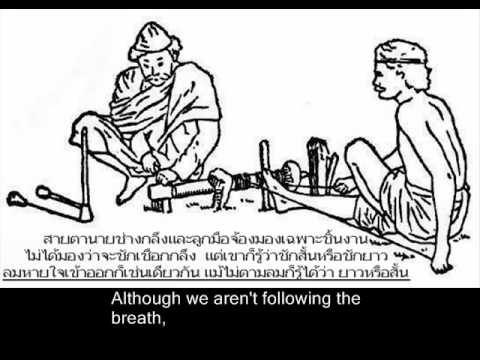
Breathing Meditation The Lord Buddha’s breath meditation teachings. Three things we have to know in meditation process. 1.Have to know: Touching surface of The door’s breathing. 2.Have to know: That time Inhale or Exhale. 3.And the most important is.: Have to know Long or Short breath by the time spending. อ่านต่อ Thai version only[aero1.bloggang.com] http ( It’s normally do not control a breathing system.) Remember Just only KNOW. Lord Buddha’s comparison for Breathing Meditation such as The Lathe craftsman and/or his assistant are turning lathe. Thus Sight of them look at formed wood, they didn’t care with rope At the same time, They know lathe rope which long or short moving. Breathing Meditation is the same, Although we aren’t following the breath, but we know that long or short by the time spending. 1.Have to know: Touching surface of The door’s breathing. 2.Have to know: That time Inhale or Exhale. 3.And the most important is.: Have to know Long or Short breath by the time spending. อ่านต่อ Thai version only topicstock.pantip.com ( It’s normally do not control a breathing system.) Remember Just only KNOW. Lord Buddha’s comparison for Breathing Meditation such as The Lathe craftsman and/or his assistant are turning lathe. Thus Sight of them look at formed wood, they didn’t care with rope At the same time, They know lathe rope which long or short moving. Breathing Meditation is the same, Although we aren’t following the breath, but we know that long or short by the

Secrets Of The Awakened Mind
Anna Wise Awakened Mind Brain Wave Training, Optimize Abundance, Creativity, Intuition, Personal Healing And Improved Relationships. Forty Years Of Real World Testing, Learn The Complete System.
Secrets Of The Awakened Mind
Which Music Is Most Appropriate To Reach A Deep Meditation State?

Article by Amy C.

The music used in meditation does not have to be specially recorded for it to be effective. To reach a meditative state you could listen to any music that makes you feel comfortable and relaxed. Of course, you will find more benefits in listening to tracks like new age music because these sound tracks are specially created for people who enjoy meditation.

Sounds of nature are very relaxing too. Indoor fountains are one of the best ways to recreate relaxing and soothing sounds of waterfalls. Same applies to sounds of ocean and rain drops.

There are many online hubs that specialize in creating meditative music. For instance, Amazon has a whole section of music dedicated to sound-tracks that are useful in creating deep meditative states.

When choosing the right track keep in mind that the first impression could mislead you. It often happens that you may initially like some track, but soon it becomes boring after two or three days, you do not want to listen to it anymore. On the other hand, some songs, which do not seem to be great at the beginning, become your favorite hits in a few days or weeks. This is something you need to be aware of when choosing your online mediation music.

The purpose of music has been to improve a personal health, to promote a self-growth and to give people a sense of fulfillment. Specifically, the music that is created to alter brain wave patterns is regarded to be very helpful when it comes to improving your psychological and spiritual health.

The main feature of the meditation music is to predispose you so you can experience mediation and to help you remain in that state. Although it may sound too obvious, you can actually forget about this when you choose a meditation track online. That is why it is important to try to “transfer” yourself in those quite place you intend to meditate, when you selecting your meditation music.

Some extra tricks applied in the music can even enhance additionally your meditation. For example, the music enhanced with binaural beat can influence on several conscious and sub conscious levels. Music enhanced with binaural beats and other subliminal technology is considered to create lasting levels of psychological changes.

The best thing about the meditative music is that it will help you eliminate pain, heal your deeper emotional wounds, and help you in accelerated learning as well as entering into the new level of consciousness.

About the Author

Amy C. invites you to browse exquisite collection of indoor fountains to fill your home with soothing sounds of water and create a home decor filled with calming and relaxing elements.

Raja Hatha yoga meditation

Article by Beyond-meditation

Raja yoga meditation is the real path of achieving success in yoga and establishing equilateral relationship between our mind, body and soul. Body is externally appearing, mind resides inside it and our spirit is in the deepest core. Soul has three subcategories and there are: consciousness, intellect and sub consciousness. Thoughts originate in our subconscious and flow into the conscious mind, during this phenomenon, feelings and emotions are created as byproducts. Feeling binds our thoughts. Intellect acts like a controller, so allows only positive and friendly thoughts to play in our mind and affect our body accordingly. Raja Yoga meditation is so highly practiced because it drives to the destination of enlightenment and directs control and mastery of the mind. This approach makes Raja Yoga an extremely challenging and difficult practice to involve in. Raja yoga aims to control the body and breathe to stabilize our prana that in turn calms the mind. Raja Yoga is often quoted as classical yoga or Hatha Raja yoga as it was the oldest system of yoga which finally developed into scientific and systematic culture. “Raja yoga” is initiated by Patanjali, who learn yoga for enlightenment in the fresh environment of Himalayas. The Yoga Sutras of Patanjali break down the practice of Raja yogic meditation into eight limbs or sub-practices. The first four limbs are referred to as the external limbs and the remaining four are named as internal. Four external limbs are: Yama, Niyama, Asana and Pranayama. Yama and Niyama are the yogic laws of right conduct and lifestyle. Yama includes truth speaking, feeling of non-violence, love and respects for others, honesty and non-covetousness. Niyama is for developing positive self-encouraged activities, and includes discipline, purity, contentment, self-study as well as devotion to supernatural being. According to raja yoga Vivekananda, the third limb, Asana means simply finding our comfortable yet stable sitting position before performing yoga practice. Forth limb of yoga is Pranayama, the science of yogic breathing. Patanjali suggests the Raja yogi to observe and slow the breath down to the point where one cannot distinguish between the inhalation and the exhalation. After preparing for external yoga, one proceeds towards the practice of internal limbs of yoga: Pratyahara, Dharana, Dhyana, and Samadhi. Pratyahara is the drawing of the mind’s concentration away from the external senses to the inner sensations. When the mind draws inwards, Dharana is used to focus our mind on a single object, which is often breathing. This time the practice becomes challenging, keeping the mind focused and preventing attachment with thoughts. When one acquires the ability to focus the mind only on breathing to the point of being totally absorbed in it, then next limb called Dhyana or meditation begins. Finally, the uninterrupted practice of Dhyana leads to the last limb, Samadhi. Enlightenment, this means ultimate bliss or renunciation. At this stage of raja yoga meditation, yogi is completely free from all types of cosmic attachments.

About the Author

I am a Yogi (shaping my mind for enlightenment) and I blog about Yoga practice, Meditation, Memory sharpening tricks and sometimes my personal struggle. Yoga and meditation-plus memory tricks

Meditation And Meditation Benefits

Article by Linus Xavier

Broadly speaking meditation can be defined as a self induced change of state of mind for the purpose of heightening certain awareness or attention, or for emotional well being.

However, the narrower definitions vary according to the beliefs surrounding them. As beliefs differ among different people, so the understanding and practice of meditation differ just as greatly.

Some of the more commonly known types of meditation tend to be the legacies of the Eastern religions, but there are aspects of it in many of the Western beliefs as well.

From prehistoric times, ritualistic repetitive movements and chants were discovered to induce a state of conscientiousness which was believed to appease the supernatural that they worshipped. It usually went alongside offerings and sacrifices to the gods.

When it became apparent that these spiritual rituals seemed beneficial to the people who performed them, they began to change and develop them in order to realise the self, but generally still for religious purposes.

The Oriental religions such as Hinduism and Buddhism refined meditation as a means for achieving a higher state of spiritual growth and goodness. The word for

The Many Faces of Yoga

Article by Andy Bowen

Yoga is a scientific system of physical and mental practices that originated in India more than three thousand years ago. It is much more than sitting in a lotus position and chanting in unison, rather, Yoga is an ancient Indian philosophy that enhances personal growth and well being. There are many different styles of Yoga, and whilst it is fun and challenging it is worth considering which Yoga is right for you.

Bhakti YogaThis is the path of pure spiritual devotion, love and surrender to God.

Hatha yogaIntroduced by Yogi Swatmarama in the 15th century, Hatha Yoga is considered a preparatory stage towards Raja Yoga. Hatha yoga concentrates on physical purification to ensure that the body is fit enough to practise “Higher Meditation”. Hatha is what most Westerners would associate with Yoga.

Chair YogaChair Yoga, not surprisingly, is a gentle form of Yoga practised whilst sitting in a chair (or standing using a chair for support). Chair Yoga is most commonly practised by people who are unable to perform other types of yoga for health or fitness reasons.

Sahaja YogaA unique method of meditation based on an experience called Self Realization (Kundalini awakening) that can occur within each human being. Created by Nirmala Srivastava, or “Shri Mataji Nirmala Devi” or “Mother” as she is also known by followers Sahaja Yoga also refers to the Sahaja Yoga International Organization which she founded in 1970 in Nargol, India.

Anusara YogaAnusara Yoga is a style of Hatha Yoga, developed by John Friend in 1997 with a Tantric Philosophy.

Iyengar YogaCreated by B.K.S. Iyengar, Iyengar Yoga uses props, such as belts and blocks, as aids in performing its postures. It is another form of Hatha Yoga and is considered a powerful tool to relieve the stresses of modern-day life.

Karma YogaOne of the four pillars of yoga Karma Yoga focuses on the adherence to duty while remaining detached from the reward. In other words, one can attain Moksha (salvation) or love of God (bhakti) by performing duties in an unselfish manner for the pleasure of the Supreme.

Kundalini YogaA physical and meditative discipline, comprising a set of simple techniques that uses the mind, senses and body to create a communication between “mind” and “body”.

Bikram YogaBikram yoga is done in a room heated to 105

Yeshi’s Luck – A Tibetan Tale : Spiritual Lessons : Video

Yeshi’s Luck – A Tibetan Tale : Spiritual Lessons  : Video

Spiritual Lessons :

“Yeshi’s Luck” A story from “Tibetan Tales for Little Buddhas.” Written,illustrated and performed by Naomi C. Rose When Yeshi loses his only horse, everyone agrees he’s had back luck. Everyone that is. except Yeshi’s father who responds to all events by chanting the Mani chant. As the reversals of fortune unfold, Yeshi and the villagers come to understand the wisdom of Yeshi’s father and the universal truths he embodies. “Naomis Tibetan Tales will bring joy to readers young and old.” the Dalai Lama “Naomi’s tales are full of living Tibetan spirit.” Geshe Kalsang Naomi C. Rose is an award-winning author, artist, and storyteller. Her books, stories, and school programs focus on the Tibetan ways of peace and kindness. www.naomicrose.com naomicrose@aol.com http Stories of Wisdom and Peace for Children of All Ages San Francisco Chronicle “… this colorful picture book … offer(s) gentle spiritual lessons and stories of adventure… Rose’s vivid color paintings draw the reader in and move the stories along.” Naomi’s next book and short film “The Mani Man” “Without inner peace, it is impossible to have world peace.” the Dalai Lama An inventive tapestry of the Dalai Lamas story, the Tibetan chant of compassion, and one of Naomi C. Roses Tibetan wisdom tales. An uplifing and inspiring film short! A Cameron/Baxter Film NAOMI C. ROSE: Painter, Teacher, Author of Tibetan Tales for Little Buddhas may be engaged to for intuitive readings/counseling and consultation on creative
Video Rating: 4 / 5

Mindfulness Meditation as well as Yoga Postures

Article by Pat Jacalyn

Conscious yoga methods accentuate a Yoga posture (asana) apply magnificently. The training of mindfulness relaxation, as well as consciousness by way of witness awareness, assists a Yoga pupil to keep yourself informed of the requires, restrictions, as well as knowledge of his / her physique, during a Yoga course. This specific awareness is very important throughout both a healthy flowing session of Yoga asanas, as well as a delicate restorative Yoga apply. In the two caser, outstanding conscious of the wants of the physique, along with one’s emotions, through a Yoga program, may help a pupil to release deeply-held anxiety along with assistance the curing of your whole body and thoughts.By simply maintaining a point out of mindfulness, and also by witnessing mind in the course of a Yoga session, a pupil will be able to assess the point out of his or her own persona. With this recognition, she or he will be able to take part in Yoga asanas and pranayama workout routines which will renew, loosen up, bolster, and feed a person’s located on most quantities. Getting conscious of what the body and also head really need, in any provided second throughout a Yoga course, may appear straightforward, but it is harder when compared with you could possibly very first think.Frequently, we have stringent objectives to live in and also our Yoga practice. While we are able to get into upward-facing ribbon and bow upon Tuesday, we should completely manage to enter this particular tough cause upon Wednesday, Thursday, and also Friday – irrespective of the day-to-day fluctuating express of our bodies. Neglecting the bodies’ wants as well as limits, through driving by means of our own latest physical condition, could cause damage along with a feeling of violence to someone’s personal. This can be the antithesis of one particular of the main tenets of the Yoga Sutras, which in turn we all know because Ahimsa or even non-harming.To stay not aware of your bodily requirements along with restrictions, and also to carry out the presents you believe you ought to be able to perform anyhow, regardless of whether one’s body damages, is definitely an work of self-harming. Improving your own body’s wants along with restrictions comes first from a non-judgmental attention of your evryday physical and emotional wants. For example, can it seem foolish that you will be having problems sustaining Sapling Create nowadays? If so, you might want to use the mindfulness relaxation approach of non-judgmental along with thoughtful pursuit of the reasons behind the don’t have of stability right now. Are you currently disappointed regarding one thing? Do you feel rushed as well as on an emotional level away stability?If that’s the case, have you any idea why? Is there another cause that will better enable you to floor, middle, stability, along with unwind, right now? Getting this kind of consciousness and also intelligence in to training can be an essential aspect of permitting one’s body to wind down along with trust a person. This praising of your own physical wants and also restrictions may you inside creating emotional and physical health, alleviate, and complete well being.

About the Author

For more info, go to yoga positions and also yoga instructor